
We have many international clients and we thought it might be helpful to outline the political system in France – we hope in simple layman’s terms!
France is a democratic republic. The general public will vote for the political party that they wish to run the parliamentary system.
France has a democratic parliamentary system alongside a Presidential political system. The elected President then elects his/her Prime Minister to run the parliamentary system – the government. The Prime Minister does not necessarily have to be from the same political party as the president, although co-operation is essential.
This differs to that of, for example, the United Kingdom whereby there is only a Prime Minister who runs the parliamentary system. There are 577 seats available in the French Parliament.
The French President can only run for two terms of power, so a total of 10 years (two five year terms). The Prime Minister is not restricted to any length of term in power as long as it is supported by the National Assembly.
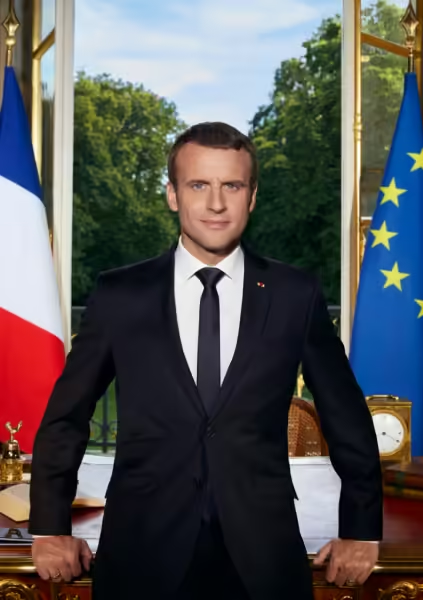
Currently, the main political parties in France are as follows:-
New Popular Front – this is left wing party that joined forces in 2024 composing of the far left wing party, La France Insoumise (LFI) (the biggest percentage of this party) and is led by Jean-Luc Mélenchon, the Socialist Party (PS), The Green Party (LV) and the French Communist party. This party came together to block the Rassemblement National (RN) getting into power. It has major differences of opinons and there are fractions within this party, which is unsurprising, given the amount of parties involved in this one party.
Ensemble – this is President Macron’s party and stands for the left movement, ecologist and solidarity alternative. It is made up of the following parties Renaissance (RE, formerly known as En Marche), Democratic Movement (MoDem), Horizons, En Commun, and the Progressive Federation.
The National Rally – this was formally known as the National Front (FN) and was founded by Jean-Marie Le Pen. His daughter, Marine Le Pen renamed the party to the Rassemblement National (RN).
The Republican Party -this is a liberal Conservative Party.
Others – making up 25 seats.
There are three sections of power in France, which are as follows:-
The Executive – this is made up of the President and the central government, which includes the Prime Minister and the ministers.
The Legislature – this is the Parliament. This is broken down into two chambers :
The National Assembly which has 577 elected seats voted for by the general public which holds a term of 5 years. These members are chosen by the public.
The Senate which consists of 348 senators who can hold a term of 6 years. These members are not chosen by the public but by the local electoral office members and members of the Assembly of French Citizens Resident Abroad.
The aim of this two tier system is to ensure that all the diverse components of French society are represented as fairly as possible.
The Speaker of the Senate is to ensure the stability of France’s institutions and can be called upon in the event of the death or resignation of the President.

The Senate
The Judiciary – the legal and court system. The Minister of Justice is called Garde des Sceaux which in English means ‘Keeper of the Seals’.

What is the difference between the President of France and the Prime Minister of France you may ask? The President is the Head of State in charge of defence and Foreign affairs. The Prime Minister is tasked with domestic affairs and seeks to control parliament. The President chooses who he or she wishes to be Prime Minister, however, they cannot dismiss them although they can ask for a resignation. The National Assembly can, however, have a vote of no confidence in the chosen Prime Minister which, at the time of writing, has happened.
Michel Barnier was appointed in September 2024 and recently had to step down due to exactly this. Edit – in the same month of writing a new Prime Minister was appointed! See our further comment below.
As the saying goes ‘A day, not a week is a long time in politics’!
France for the first time since 1958 is run by a coalition government and not by the President’s own party. At the time of writing (December 2024) there was no French Prime Minister, however, one has just recently been appointed that being Francois Bayrou.
Whilst recent turn of events are not ideal and various news outlets will provide you with their thoughts and the ramifications of these recent events, most countries, if not all, go through political upheaval and uncertainty. France is no exception but it still remains a major influence and economy in the world, not to mention being the number one top tourist destination.
This is one of the many reasons people chose to leave their native country and live here full-time, and we do not see that changing anytime soon, irrespective of the country’s politics.
We hope you enjoyed this brief outline of the way in which France is governed.